Scaling Shopify Apps for Large Product Catalogs

Scaling Shopify Apps for Large Product Catalogs
Managing large product catalogs on Shopify is challenging but achievable with the right strategies. If your store has thousands of SKUs, you likely face issues like slow page loads, API rate limits, and poor navigation, all of which can hurt sales and the customer experience. Here's how to tackle these challenges:
- Performance Optimization: Use GraphQL over REST API for faster data handling, implement caching (e.g., Redis), and leverage CDNs like Cloudflare to improve page load times.
- Efficient Data Management: Organize products with Smart Collections and Metafields to streamline filtering, searching, and bulk updates.
- Search & Recommendations: Advanced tools like Algolia and AI-powered apps (e.g., sImage) enhance search precision and show visually similar products, boosting engagement and conversions.
- Bulk Management: Automate repetitive tasks like price updates or inventory changes to save time and reduce errors.
Challenges of Managing Large Product Catalogs on Shopify

Performance Bottlenecks with Large Catalogs
Once your store surpasses 50–100 products, performance issues start cropping up, and they only grow worse as your catalog expands. Shopify's REST API imposes a 2-requests-per-second limit, which can create significant delays when syncing or filtering data across thousands of SKUs. During peak shopping hours, these delays become even more noticeable as apps fetch data like product variants or metafields for catalogs with 1,000+ items. It’s like trying to funnel a flood through a garden hose - it just doesn’t flow fast enough.
Server response times also suffer, especially when dealing with products that have 100+ variants. The backend has to process complex database queries, which can lead to timeouts during inventory updates or search operations. If your store lacks smart collections or a well-organized hierarchy, these inefficiencies compound. Bulk tasks, such as updating prices for 5,000 SKUs during a sale, can become error-prone and frustrating without the help of specialized apps designed to handle such heavy lifting. These delays don’t just irritate you - they directly impact your customers’ experience.
Impact on User Experience and Store Sales
When your backend struggles, your customers feel it too. Poor performance and lack of intuitive navigation can turn shopping into a frustrating chore. Ineffective filtering systems cause shoppers to abandon their carts simply because they can’t find what they’re looking for. If your catalog grows beyond 100 products but your navigation remains basic, the result is often a chaotic shopping experience that drives potential buyers away.
The sales impact is real. Stores with poorly optimized catalogs often face higher bounce rates, as slow-loading pages and irrelevant search results frustrate visitors. Without features like intent-driven collections (think "Gifts Under $50") or advanced filtering tools, even eager buyers may struggle to sift through catalogs with 1,000+ SKUs. On the bright side, tools like AI-powered image analysis can help alleviate some of these issues by quickly surfacing the most relevant products. Addressing these challenges is essential to keeping your customers engaged, improving conversion rates, and ensuring your store’s search and recommendation features work effectively.
Dynamic Pricing Strategies with Shopify's API Using Node.js | Shopify Tutorial
Optimizing Shopify Apps for Large Product Catalogs
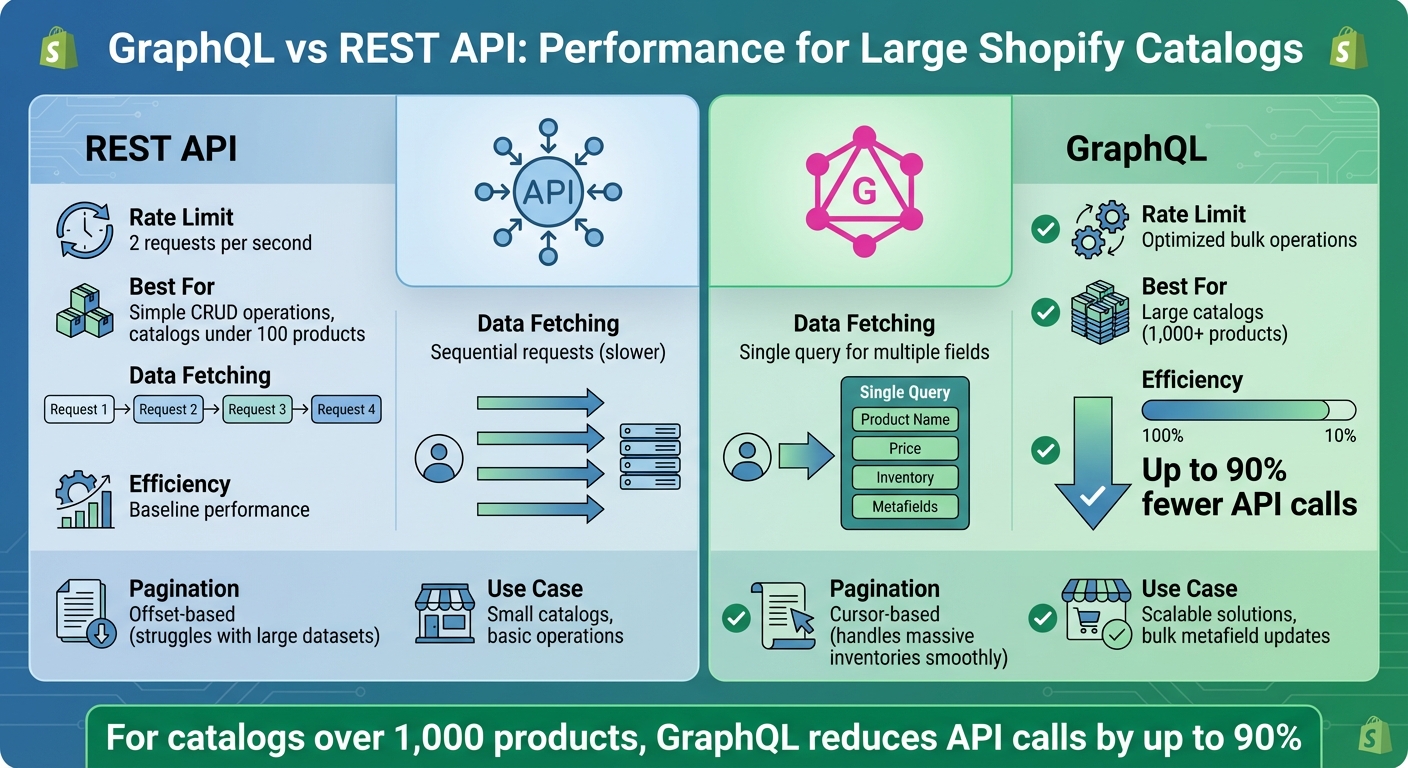
GraphQL vs REST API Performance Comparison for Shopify Large Catalogs
Using Collections and Metafields for Efficient Data Handling
Structuring data effectively is key to overcoming performance challenges in Shopify apps. Smart Collections automatically group products based on predefined conditions like tags, vendors, or price ranges. For example, tagging products with "summer_sale_2025" allows a Smart Collection to organize those items automatically, eliminating the need for constant API calls to manually sort products.
Metafields provide a way to store custom data - such as material type, fit, or seasonal attributes - directly on each product. Apps can leverage tools like Matrixify to query this data in bulk, avoiding the inefficiency of individual API requests. For instance, a product like "Men's Linen Shirt" could include tags like "material-linen, fit-slim, season-summer" alongside metafields for size and price. This setup enables faceted filtering and supports prebuilt collections, such as "Gifts Under $50".
GraphQL vs REST API: Choosing the Right Approach
When managing large product catalogs, GraphQL stands out for its efficiency. It allows you to request only the fields you need - like titles, images, or variants - in a single query. Bulk operations in GraphQL can update metafields for thousands of products at once, cutting down API calls by up to 90% compared to the sequential requests required by REST. Additionally, GraphQL's cursor-based pagination handles massive inventories smoothly, avoiding the offset limitations that REST encounters with larger datasets. This efficiency translates into faster load times and a better user experience, addressing earlier performance concerns.
On the flip side, REST API works well for simpler CRUD operations but struggles with the complexities of large catalogs. For apps managing fewer than 100 products, REST may be sufficient. However, for scalable solutions, GraphQL's precision and ability to handle bulk operations make it the better choice.
These API optimizations lay the groundwork for implementing effective caching strategies.
Caching and CDN Integration for Faster Load Times
Caching is an essential tool for reducing server strain when dealing with extensive product catalogs. Client-side caching, such as using Apollo Client for GraphQL, can store query results for 5 to 60 minutes depending on data volatility. On the server side, caching solutions like Redis efficiently handle frequent queries, such as product lists. Dynamic data, like pricing, benefits from short time-to-live settings (around one minute), while static data, such as metafields, can be cached for longer periods to balance freshness and performance.
CDNs (Content Delivery Networks) like Cloudflare or Shopify's edge caching distribute static assets - such as images and JSON product feeds - across servers worldwide. This approach can cut latency by 50–200 milliseconds for U.S.-based stores and offload over 80% of image requests. For example, CDN-cached product thumbnails enable recommendation engines to deliver sub-one-second load times, even for stores with inventories exceeding 8,000 products. By integrating CDNs through app proxies or theme assets, stores can maintain smooth performance even during high-traffic periods without overwhelming the backend systems.
sbb-itb-521eef9
Improving Search and Recommendation Features for Large Catalogs
Efficient data handling and caching are just the beginning. Advanced search and recommendation tools take user engagement to the next level, especially for stores with large inventories.
Advanced Filtering and Search Tools
Faceted filtering simplifies navigation by allowing shoppers to narrow down results based on size, color, material, and price. This feature is particularly helpful for catalogs with 50 to 100 products, complementing earlier performance improvements.
Shopify Search & Discovery provides built-in tools to refine search results. It allows merchants to define synonyms (e.g., "tee" matching "t-shirt"), prioritize high-margin products, pin best-sellers at the top, and create filters based on metafields tailored to U.S. standards, such as shoe sizes or price ranges in dollars.
For larger catalogs, especially those with thousands of SKUs or complex B2B inventories, Algolia offers sub-second search capabilities. It features typo tolerance, relevance ranking, and supports multi-attribute queries like filtering by color, size, and price simultaneously. These enhancements can boost conversion rates by 20–30% through faster and more precise results. Many stores managing over 5,000 products find the investment worthwhile for the performance improvements.
AI-Powered Product Recommendation Systems
While advanced filtering fine-tunes search results, AI-powered recommendations take product discovery to another level by focusing on visual aesthetics. Visual similarity recommendations address the limitations of text-based searches by identifying products with similar styles. This is especially valuable for categories like apparel, accessories, furniture, and home decor, where style significantly influences purchasing decisions.
Tools like sImage use AI-driven image analysis to identify visually similar products and display them directly on product pages - no coding required. For example, The Dutch Tile Project reported impressive results after implementing sImage:
"This app has been a game-changer for my Shopify store! It's incredibly user-friendly and integrates seamlessly with the latest themes. The 'similar items by image' functionality has improved customer experience significantly by offering visually relevant product recommendations. Since implementing this app, I've noticed a reduction in bounce rates and an increase in sales from upselling and cross-selling."
For stores with thousands of SKUs, visual recommendations provide a balance between performance and engaging customer experiences. The system supports catalogs of up to 8,000 products, with custom enterprise plans available for even larger inventories. Pricing starts at $6/month for up to 500 products and scales to $60/month for larger catalogs. For U.S. merchants, this no-code solution makes it easy to test different placements - like above or below product descriptions - without needing a developer. Combined with strong caching and CDN strategies, these AI recommendations typically load in under two seconds, even during peak traffic, helping to keep customers engaged and increase average order values.
Case Study: Scaling sImage for Large Shopify Stores
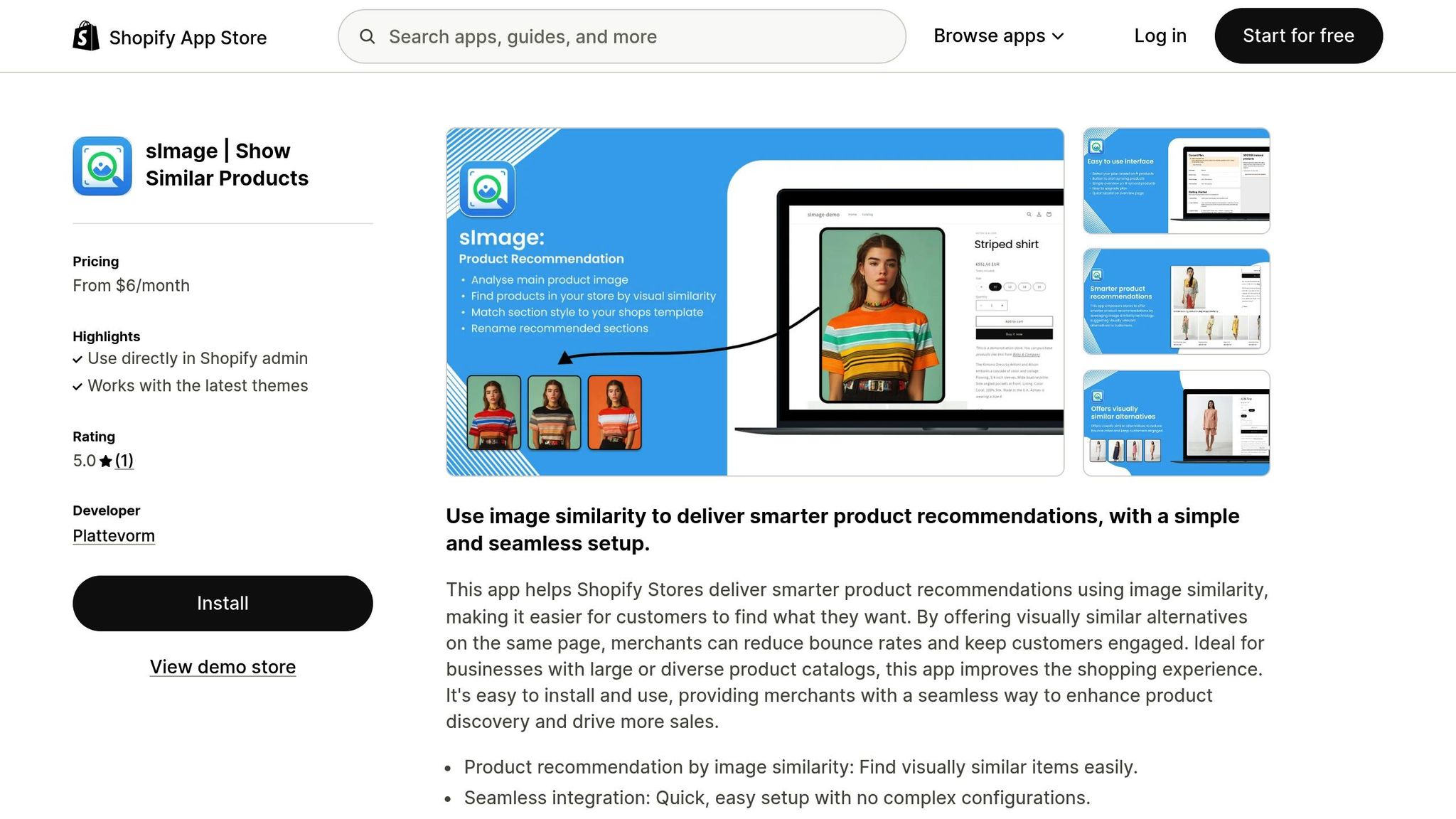
sImage is designed to handle thousands of SKUs while maintaining speed and a seamless user experience. Its efficiency is built on advanced API strategies and smart caching techniques.
Managing Catalogs with Up to 8,000 Products
The Champion plan, priced at $60/month, is tailored for U.S.-based mid-to-large Shopify stores, supporting catalogs of up to 8,000 products. To stay within Shopify's API rate limits, sImage employs incremental synchronization and cursor-based pagination. Product images are processed into compact vectors using computer vision technology and stored in an optimized index, enabling quick similarity searches even for extensive catalogs.
For stores with more than 8,000 products, custom enterprise plans offer specialized solutions like dedicated databases, sharding, and custom synchronization schedules. This ensures consistent performance even for catalogs containing tens of thousands of SKUs. The initial full-catalog sync runs in the background, taking anywhere from a few minutes to a couple of hours, depending on the catalog's size. Importantly, this process doesn't interfere with storefront access or disrupt high-traffic periods.
Code-Free Theme Integration
Beyond technical efficiency, sImage is built for ease of use. Integration is quick and straightforward, requiring no coding skills. Using Shopify theme app extensions, merchants can add visual recommendation blocks directly through Shopify's visual editor. This eliminates the need to modify Liquid templates.
Through Shopify's theme editor, merchants can add a "Similar Images" block in just minutes. They can adjust settings like the number of recommendations (typically 4–8 items), layout options (grid or carousel), and display rules through the app's interface.
The widget is designed to lazy-load after the main product content, preserving Core Web Vitals. Assets are bundled, compressed, and served via a CDN optimized for U.S. traffic, ensuring mobile shoppers on 4G or 5G networks experience smooth, fast-loading recommendations without delaying primary product details. A real-world example of this is the Dutch Tile Project, which reported lower bounce rates and higher sales from upselling and cross-selling after implementing sImage. This underscores the app's ability to enhance both performance and user experience effectively.
Conclusion
Scaling Shopify apps to handle large product catalogs demands a mix of technical precision and operational foresight. The secret lies in organizing your data early - leveraging tools like smart collections, metafields, and structured product types. This approach ensures your app doesn’t get bogged down trying to process everything in real-time when catalogs expand to thousands of SKUs. Using GraphQL helps minimize over-fetching with targeted queries, while combining REST endpoints with caching and CDN integration ensures fast, reliable performance during high-traffic events like Black Friday.
With these optimizations in place, merchants can turn catalog management from a headache into a revenue driver. Tools powered by AI recommendations, such as sImage, show how visual similarity can transform massive catalogs into engines of growth. Take the Dutch Tile Project as an example: they successfully reduced bounce rates and boosted sales through effective upselling and cross-selling - proof that well-designed apps can maintain performance while scaling.
Bulk management is another critical piece of the puzzle. It ensures consistency across thousands of SKUs, reducing errors that can disrupt search functionality or recommendation engines. By automating repetitive tasks, you not only prevent mistakes but also maintain catalog accuracy, which directly impacts customer satisfaction and conversion rates.
Don’t wait to measure your performance. Start tracking key metrics like collection page load times, search latency, and API error logs. Strengthen your infrastructure with caching layers, fine-tuned faceted search, and bulk management tools now - before your catalog outpaces your current setup. Build with the future in mind, preparing for the demands of AI-driven personalization and ever-rising customer expectations.
FAQs
How does GraphQL enhance performance for large Shopify product catalogs?
GraphQL improves how large Shopify product catalogs perform by making data retrieval more efficient. Instead of pulling in unnecessary information like traditional APIs, GraphQL lets you request exactly what you need in a single query. This reduces the number of API calls and lightens the load on servers.
This method works particularly well for stores with massive product collections. It speeds up response times, creating a smoother experience for both developers and customers. By fine-tuning data fetching, GraphQL simplifies managing large catalogs and helps ensure everything runs more smoothly.
How can AI-powered product recommendations benefit Shopify stores with large product catalogs?
AI-driven product recommendation tools can transform the shopping experience for Shopify stores, particularly those with large product catalogs. By analyzing product images and suggesting visually similar items, these tools can guide customers toward relevant options more effortlessly, creating a smoother and more engaging shopping journey.
Some standout advantages include more opportunities for cross-selling, an increase in average order value, and fewer bounce rates. These recommendations not only simplify the process of finding desired products but also encourage higher sales and enhance overall store performance.
Why is caching essential for managing large product catalogs on Shopify?
Caching is a game-changer when it comes to handling large product catalogs on Shopify. By cutting down the number of API calls, it eases the load on servers and boosts overall performance. This means your store can deliver product data much faster, leading to quicker page load times and a more seamless shopping experience for your customers.
With its ability to manage large inventories efficiently, caching ensures your Shopify app can grow without sacrificing speed or dependability - even when you're managing a vast catalog of products.