5 Cross-Selling Strategies Using AI Product Tools
5 Cross-Selling Strategies Using AI Product Tools
Want to boost sales without finding new customers? Cross-selling with AI tools is the answer. Selling to existing customers is 3x cheaper than acquiring new ones, and AI makes it easier to recommend the right products at the right time. Here’s how AI tools can help:
- Visual Recommendations: AI like sImage suggests similar products based on appearance, helping customers find variations or matching items effortlessly.
- Bundling Offers: Tools analyze buying patterns to recommend complementary products (e.g., a camera with a memory card), increasing cart value.
- Behavior-Based Suggestions: AI tracks browsing habits to recommend items when customers are most likely to buy.
- Catalog Segmentation: AI organizes product catalogs based on customer data, presenting tailored suggestions.
- Visual Discovery: Shoppers upload photos to find matching products, ideal for style-driven industries like fashion or home décor.
Why it works: AI tailors recommendations, boosts average order value, and improves customer experience. For example, Amazon attributes 35% of revenue to AI recommendations, and brands using bundling have seen sales jump by 40%. With easy Shopify integration and no coding required, these tools are simple to implement.
AI-powered cross-selling turns casual shoppers into loyal customers while increasing revenue. Start small - add “Frequently bought together” sections or visual discovery tools - and watch your sales grow.
1. Visual Similar Product Recommendations Using sImage
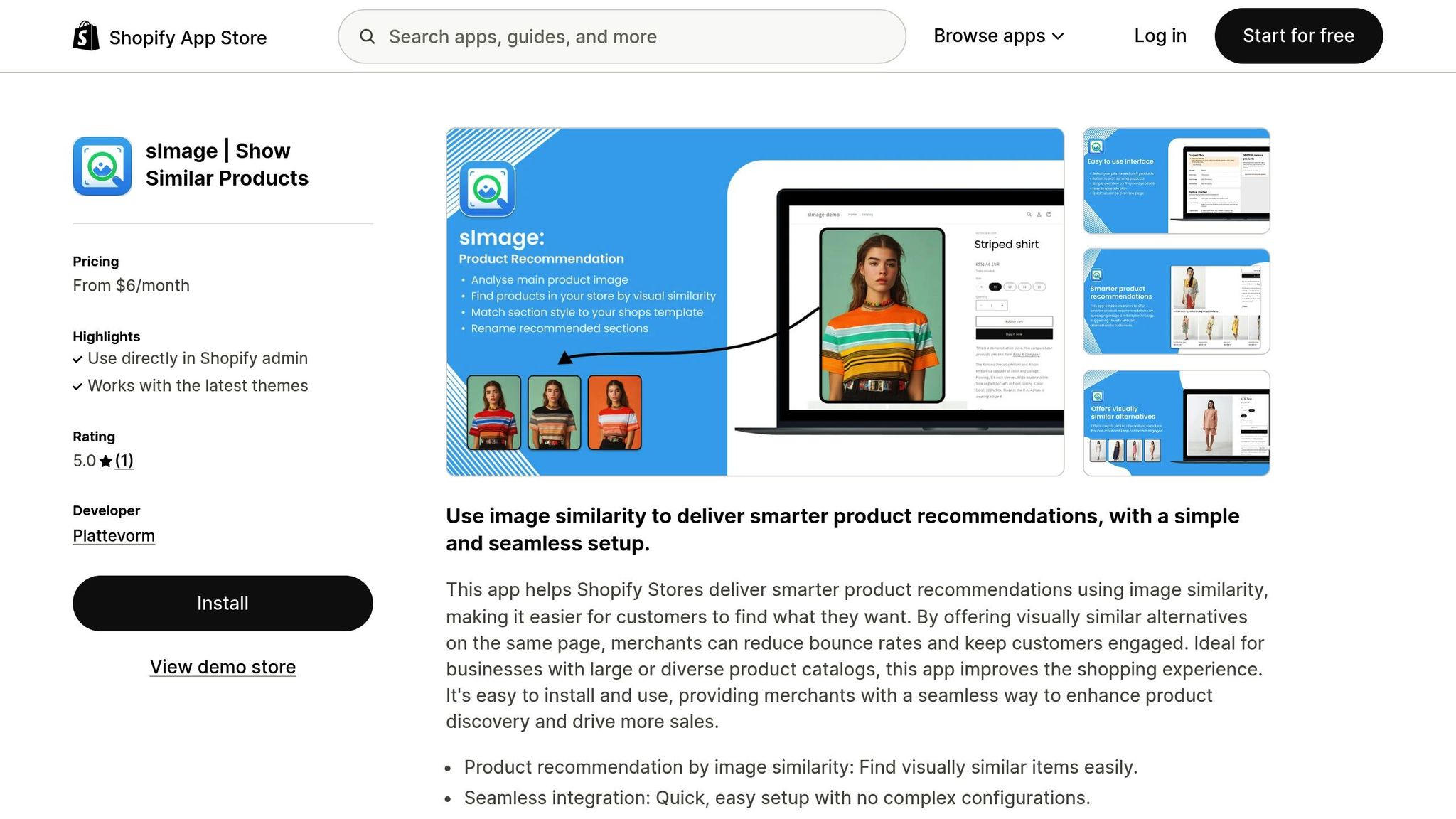
Sometimes, customers might be looking for a different color, style, or variation of the product they're viewing. That’s where sImage steps in. Using AI-powered computer vision, it analyzes product details like color, shape, fabric, and brand to instantly suggest visually similar alternatives. This eliminates the need for tedious manual searches by displaying the most relevant options directly on the product page. It’s a smarter way to enhance product discovery while creating opportunities for increased sales.
Impact on Average Order Value
By making product discovery effortless, visual recommendations can naturally boost the number of items in a customer’s cart. Features like “Pairs well with…” or “Complete the look” can be seamlessly integrated into product pages without overwhelming the design. For instance, if a customer is browsing sunglasses, the system might suggest a matching case or a lens cleaning kit. These subtle yet relevant suggestions can encourage additional purchases, increasing the average order value when they feel intuitive and helpful.
How It Matches Customer Shopping Patterns
sImage leverages content-based filtering, focusing on the product’s specific attributes - like features, categories, and visual elements - rather than relying on what other customers have purchased. This makes it especially effective for niche stores, as it doesn’t depend on vast user data. Instead, it uses the current product being viewed to identify visually similar items, ensuring recommendations are tailored and precise.
Shopify Integration Process
Setting up sImage with Shopify is quick and straightforward. Here’s how it works:
- Install the app from the Shopify App Store.
- Let the AI analyze your product images.
- Watch as personalized recommendations automatically appear on your product pages.
No coding is required, and the app integrates effortlessly with modern Shopify themes. Merchants often report improved customer experiences shortly after integration.
Automated Catalog Management
sImage takes the hassle out of managing product catalogs. Its AI continuously analyzes your inventory to identify visually compatible items - no manual tagging needed. It even ranks these items based on similarity, adapting in real time as new products are added. This is a game-changer for stores with large inventories or frequent updates, ensuring recommendations remain fresh and relevant without constant effort.
2. AI Bundles and Frequently Bought Together Offers
AI-driven bundling is taking product recommendations to the next level by focusing on functional pairings that make sense for shoppers and boost sales. Unlike visual recommendations that rely on product appearance, these tools use collaborative filtering to analyze actual purchasing patterns. For instance, if someone is checking out a camera, the AI might suggest adding a memory card and a protective case. Why? Because others who bought that camera often purchased those items too. This approach is especially effective for products that naturally complement each other, helping customers find what they need while increasing order value.
Impact on Average Order Value
The numbers don’t lie - this strategy works. Amazon attributes more than 35% of its revenue to AI-powered product recommendations, and brands using similar tools have seen conversion rates jump by at least 40%. Take Lathr, a personal care brand, for example. In 2025, they introduced bundling options that allowed customers to build their own routines, leading to $17,221.79 in additional sales in just 30 days. Another success story comes from Jasper Caven, a German health supplement brand. They used time-sensitive bundle offers at checkout, generating €14,000 in extra revenue from 154 orders over 35 days. Interestingly, checkout pages tend to outperform product pages for bundle acceptance, often by two to three times.
How It Matches Customer Shopping Patterns
AI doesn’t just stop at offering bundles - it gets smarter over time. Modern systems combine collaborative filtering (what similar customers bought) with content filtering (the specific features of products a shopper has interacted with). This means the AI looks at browsing history, purchase behavior, and product ratings in real time to make suggestions that stay relevant throughout the shopping session. It’s like having a personal shopping assistant that knows exactly what you might need next.
Shopify Integration Process
Setting up an AI bundling app on Shopify is straightforward. Using the app’s setup wizard, you can add bundle offers directly into the checkout process, where they’re most effective. Once installed, the AI takes over, analyzing purchase history and customer interactions to refine its recommendations. The best part? There’s no need for coding. The system automatically adjusts to your store’s data, saving you time and effort.
Automated Catalog Management
AI bundling tools also handle catalog management seamlessly. They analyze product metadata and customer behavior to create recommendations without requiring manual input. Plus, they sync with your inventory in real time, ensuring you never oversell a product. As your inventory grows and customer preferences evolve, the AI adapts automatically, keeping your recommendations relevant and your operations smooth.
3. Behavior-Based Cross-Sells Throughout the Shopping Process
AI plays an active role throughout the shopping experience, keeping track of browsing habits, items added or removed from carts, and even how long a customer lingers on a product. This allows it to deliver personalized suggestions exactly when they're most effective. For instance, if a shopper adds a product to their cart, the AI might trigger a pop-up recommending a complementary item. This well-timed nudge can lead to higher conversions. These insights align seamlessly with earlier discussions on AI-powered product recommendations.
How It Aligns with Customer Shopping Habits
AI combines collaborative filtering with contextual data to predict what shoppers might want next. It doesn’t just analyze your actions - it also looks at what similar customers have purchased. Then, it layers in details like your location, local weather, and even the time of day to refine its recommendations. Starbucks is a great example of this in action. Through its mobile app, it suggests food pairings or seasonal drinks based on your purchase history, the time of day, and weather conditions. For example, on a chilly morning, the app might recommend a hot latte, while on a sunny afternoon, it could suggest an iced beverage [4,20]. This kind of personalized experience ties directly into AI’s ability to enhance sales and optimize product offerings.
The numbers back this up. Seventy-two percent of consumers say they only engage with messaging that aligns with their interests. Additionally, 77% of shoppers admit they’ve chosen or paid more for brands offering personalized experiences. Even more telling, half of online buyers have made impulse purchases after receiving a personalized promotion. Consider the success stories: in 2025, wellness brand Living Nutritionals increased its revenue by 139% with behavior-based recommendations, while DoorStepInk saw an 85% revenue boost from consistent AI-driven suggestions.
Shopify Integration Process
When it comes to Shopify, integrating these tools is straightforward and effective for real-time cross-selling. You can add a cross-selling tool using a JavaScript snippet or a Checkout Extension. From there, the AI processes real-time signals like browsing history, cart activity, search queries, and past purchases to generate personalized recommendations [22,19]. During the initial learning phase, fallback models display popular or trending products. Once the system is fully operational, you can strategically place recommendations across the customer journey - on homepages, product pages, shopping carts, checkout pages, and even in post-purchase emails.
Boosting Average Order Value
The impact of personalized suggestions is undeniable. Stores using these strategies see conversion rates up to 4.5 times higher compared to those that don’t. Nearly half of consumers (49%) report buying something they didn’t plan on after receiving a personalized recommendation. Furthermore, 80% of business leaders have observed that customers spend 38% more when their shopping experience is tailored to them. To maximize effectiveness, limit recommendations to three to five products to prevent overwhelming shoppers. Placing these suggestions strategically - like on the checkout page - can lead to last-minute cross-sells that significantly increase the average order value [19,25].
4. AI-Powered Catalog Segmentation and Merchandising Rules
AI takes the guesswork out of organizing your catalog by diving deep into customer data - like demographics, search habits, purchase history, and product details. Instead of manually deciding what to feature, machine learning algorithms handle the heavy lifting. They segment your inventory and set up merchandising rules that adjust based on how shoppers behave. This is a game-changer for stores with massive catalogs, where customers might otherwise get lost scrolling for what they need.
How It Matches Customer Shopping Patterns
The smartest systems use hybrid filtering, blending two approaches: collaborative filtering (suggesting items based on what similar customers bought) and content-based filtering (highlighting products with specific features like color, size, or category). For instance, if someone is browsing winter coats, the AI might suggest matching scarves - not just because they go well together but also because other coat buyers have made that choice. And the numbers back it up: 56% of shoppers are more likely to return after a personalized experience, and nearly 50% of US shoppers in 2023 actively sought tailored product recommendations. This kind of segmentation makes Shopify's catalog integration feel effortless.
Shopify Integration Process
Getting these tools up and running on Shopify is simple. You can use Shopify Magic, the platform’s built-in AI, or explore third-party integrations from the Shopify App Store. These tools sync directly with your store’s data, ensuring smooth and consistent recommendations. To make the most of it, though, your product metadata - like descriptions, categories, and features - needs to be thorough and accurate. This is especially important for niche markets where customer interaction data might be limited.
Impact on Average Order Value
AI-generated recommendations can have a direct impact on sales. By presenting relevant options at the right time, the AI encourages additional purchases, boosting the total order value. The key is to focus on quality over quantity - suggesting items that genuinely make sense rather than overwhelming shoppers with too many choices. When done right, this approach leads to higher order totals and a smoother shopping experience.
sbb-itb-521eef9
5. Visual Discovery for Style-Focused Shoppers
For brands in fashion, home décor, and lifestyle, visual discovery is reshaping how customers find products. Instead of typing keywords, shoppers can upload a photo and instantly see items that match. This image-first approach pairs seamlessly with AI recommendations, creating a smoother and more personalized shopping experience.
How It Matches Customer Shopping Patterns
Shoppers with a strong sense of style often know exactly what they want. They’re not just looking for "a blue dress" - they’re after a specific shade, cut, and overall vibe. Visual search tools powered by AI analyze uploaded images to find products that match in terms of color, pattern, and design elements. It’s like having a personal stylist who knows your preferences. By limiting recommendations to just a few highly relevant options, these tools avoid overwhelming shoppers. Using high-quality visuals - like crisp photos or short videos - also helps customers make faster decisions. Adding this feature to your Shopify store is straightforward and doesn’t require technical expertise.
Shopify Integration Process
Adding visual discovery to your Shopify store is simple with tools like sImage. This app uses AI to scan your product catalog and match items based on visual similarities. Once installed, sImage integrates directly into product pages, showing relevant suggestions. For instance, if a customer is browsing earrings, they might see a matching necklace displayed alongside. The setup is seamless and works with your existing product data.
Impact on Average Order Value
Visual discovery doesn’t just enhance the shopping experience - it also drives sales. In 2024, Ikea launched an AI assistant that lets shoppers upload photos to get tailored furniture and décor suggestions. Francesco Marzoni, Ikea's Chief Data and Analytics Officer, noted that 20% of these interactions led to store visits. More broadly, AI-powered tools like visual assistants and chatbots have been shown to increase online retailer revenue by 7% to 25%. Brands using cross-selling techniques for complementary items have reported profit increases of about 20%. Visual discovery fits perfectly into this strategy, encouraging larger cart sizes and offering a cohesive shopping experience that keeps customers coming back.
Comparison Table
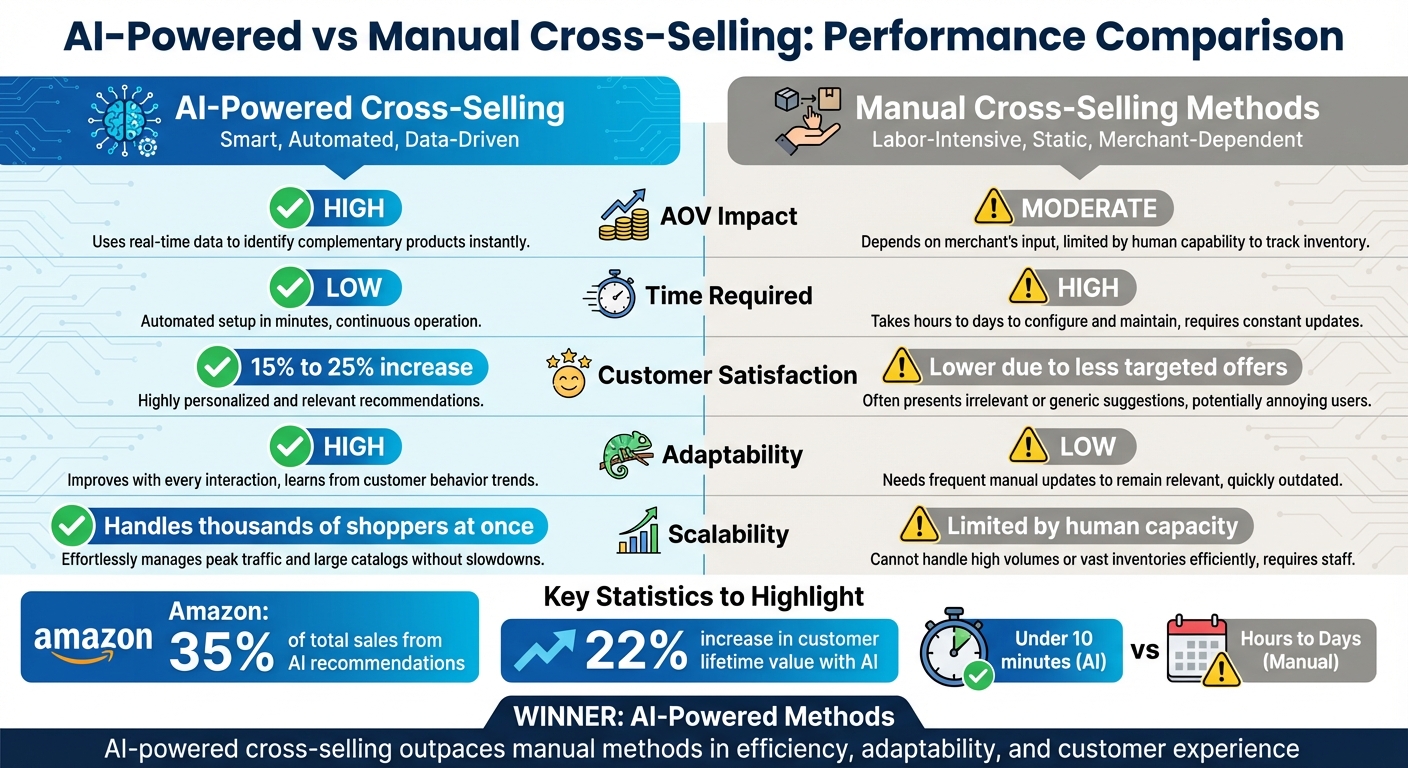
AI-Powered vs Manual Cross-Selling: Performance Comparison
When it comes to boosting your average order value (AOV), saving time, and improving customer satisfaction, comparing AI-powered cross-selling with manual methods highlights some clear differences.
AI tools shine by using real-time customer behavior and purchase history to suggest tailored recommendations. For instance, Amazon attributes up to 35% of its total sales to dynamic product recommendations. Similarly, retailers leveraging AI algorithms have seen a 22% increase in customer lifetime value.
"Merchants often spend hours manually setting up product recommendations... This process is time-consuming and often lacks real insights into what truly converts."
– Ultimate Apps, Developer of MDP Ai Product Suggestions
Unlike manual methods, AI-powered apps can be set up in under 10 minutes and require no coding knowledge. Below is a side-by-side comparison to illustrate the differences:
| Feature | AI-Powered Cross-Selling | Manual Cross-Selling Methods |
|---|---|---|
| AOV Impact | High; uses real-time data | Moderate; depends on merchant's input |
| Time Required | Low; automated setup in minutes | High; takes hours to days |
| Customer Satisfaction | 15% to 25% increase | Lower due to less targeted offers |
| Adaptability | High; improves with every interaction | Low; needs frequent manual updates |
| Scalability | Handles thousands of shoppers at once | Limited by human capacity |
This table highlights how AI-powered cross-selling outpaces manual methods in efficiency, adaptability, and customer experience.
Conclusion
Using AI for cross-selling isn't just about increasing sales - it's about creating a shopping experience that feels personal and effortless. With nearly 50% of US shoppers expecting personalized recommendations today, it's clear that businesses need to embrace these strategies to remain competitive.
The five approaches discussed - ranging from visual similarity recommendations to tailored bundles - work hand in hand to enhance your average order value while keeping customers happy. And here's the kicker: 56% of shoppers say they're more likely to return to a store after a customized shopping experience. This means you're not just driving sales; you're building loyalty.
What makes this even better? The barriers to entry are low. AI tools are designed to be easy to set up and maintain, so you can spend less time on manual tasks and more time growing your business. For example, Shopify's introductory pricing - like 3 months for just $1/month - makes it affordable to test these strategies without significant financial risk.
Gone are the days of manually tagging products. AI tools automatically adapt to your inventory size, whether you're managing a small boutique with 100 products or a massive catalog with thousands of SKUs. This scalability ensures your business can grow without added hassle.
The best part? You can start small. Whether it's adding "Frequently bought together" sections at checkout, enabling visual discovery for style-savvy shoppers, or using behavioral data to personalize the experience, each strategy enhances the shopping journey. These tools turn casual visitors into loyal, repeat customers. So why wait? Start implementing these strategies today and watch your customer base grow.
FAQs
How does AI make cross-selling strategies more effective?
AI takes cross-selling to a whole new level by analyzing vast amounts of visual and behavioral data to suggest products that truly resonate with shoppers. Through visual recognition, AI identifies similarities in products - whether it's matching colors, textures, or designs - and combines this with insights from customer behavior, like past purchases and browsing habits, to predict what someone is most likely to buy next.
What makes these tools even more powerful is their ability to learn and improve over time. They adjust recommendations dynamically, keeping suggestions fresh and aligned with inventory changes - no manual tweaking required. For Shopify merchants, apps like sImage make this seamless by automatically displaying visually similar products on key pages, making it easier to drive sales without extra effort.
How can AI-powered visual discovery benefit online stores?
AI-powered visual discovery tools take product images and analyze details like color, texture, and design. Using this information, they suggest visually similar or complementary items, making the shopping experience feel personalized and effortless. This often leads to higher conversion rates, larger average order values (AOV), and more engaged customers.
What makes these tools even more effective is their ability to update recommendations in real time based on inventory. Shoppers are always shown relevant, in-stock products without the need for manual updates. Plus, with simple integration options, including no-code setups, merchants can quickly add these features to product pages, shopping carts, or even post-purchase screens. The result? A smoother shopping experience for customers and better cross-selling opportunities for businesses.
How can I add AI-powered product recommendations to my Shopify store without coding?
Adding AI-driven product recommendations to your Shopify store is a breeze, and you don’t need any coding skills to get started. Just install an app like sImage from the Shopify App Store. Once installed, the app walks you through a straightforward setup process, allowing you to decide where recommendations should appear - whether on product pages, in the shopping cart, or elsewhere.
The app uses AI to analyze your product images and links them to your catalog, suggesting visually similar items to shoppers. After setup, it integrates smoothly with your store’s theme and automatically updates recommendations in real-time as your inventory changes. Plus, you can track key performance metrics like click-through rates and average order value right from the app’s dashboard - no developer needed!